
Like the Song “Love and Marriage”… Your Forklift Battery & Charger Should be Made for Each Other
These days, replacing internal combustion engines with cleaner power sources is a hot topic, and a lot of new choices for powering forklifts have emerged. Electric forklifts now represent some 60% of the forklift market, and that sector is growing. Naturally, the heart of an electric forklift is the battery, causing an intense focus on forklift battery technology as industries search for more efficient, clean power delivery.
When considering the purchase of an electric forklift or fleet of forklifts, you should weigh the options for powering and charging them, especially in light of new choices that are potentially more cost-effective and greener.
The most important part of the decision to equip your facility is the nature of your forklift usage. Do you operate on one-shift only, or 24/7? Has your company committed to certain environmental standards? Or does your warehouse have a fleet of existing AC forklifts, and have you been tasked with developing the most efficient battery management system?
We’ll look at some of the factors to help make those decisions.
Forklift Battery Technology Drives On
While hydrogen fuel cells have also emerged as a new power source for forklifts, the bulk of the action is happening in developing more efficient batteries for electric-powered forklifts. Lithium-ion batteries, now widely used in cell phones, laptops—and now electric motor vehicles—have dramatically changed the landscape of forklift battery usage.
Lead-Acid Batteries – Still the Leading Power Driver
The lead-acid battery is still the king of the hill, with some 90% of forklifts powered by this legacy technology. Lead-acid batteries incorporate a well-developed technology and are relatively inexpensive. While they are considered a more environmentally friendly power source than propane, LPG or gas, there are still toxicity and industrial safety issues associated with handling lead-acid batteries. You can’t just pitch a lead-acid battery into the trash when its time is up, although unfortunately, some do wind up there. A robust industry of lead-acid battery reclamation and recycling has evolved, helping to reduce their overall environmental impact.

Charging Your Forklift Fleet
A fleet of lead-acid battery-powered forklifts requires a pretty extensive charging and maintenance system. Typically, lead-acid batteries are designed to deliver an 8-hour shift’s worth of effective power. The battery then needs to be recharged or replaced with a fresh battery. The latter requires heavy-duty lifting capability—especially for larger, counterbalanced forklifts—and dedicated forklift maintenance and charging area. Using a standard charger, a lead-acid battery needs 8 hours for a full charge, followed by 8 hours for cool down and degassing. This may work well for facilities that run on a one-shift per day basis, but multi-shift operations require different charging schemes or swapping out the battery at the end of the shift.
Lead-Acid Battery Maintenance
Lead-acid batteries require weekly maintenance: checking electrolyte levels and topping up with water (preferably distilled) as needed. Records should also document the power level and charging history. To get the most extended life out of a lead-acid battery, it should not be allowed to discharge past 80% during its period of usage, and a properly matched charger should be used to ensure a full charge. Operators must be thoroughly trained in these processes as there is the danger of electrolyte spillage and over-watering of lead-acid batteries. Proper PPE and eye-wash stations must be part of your lead-acid battery charging/swap-out area.
Lithium-ion Batteries
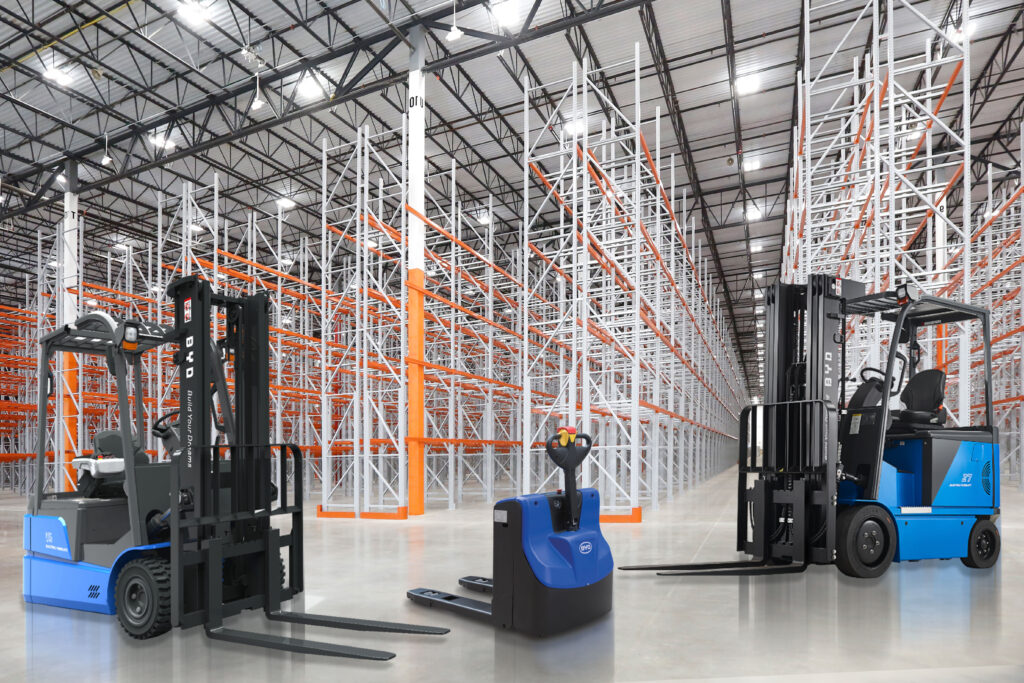
All of this sounds pretty convoluted and archaic when compared with using lithium-ion batteries. Many forklift manufacturers are now offering this innovative power source for their lift trucks. Lithium-ion batteries are long-lasting, maintenance-free, quick-charging, lightweight and safer.
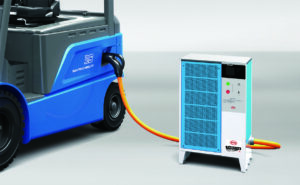 They are simple to charge; just plug ’em in and they’re fully charged in an hour or two. One downside is the upfront cost, which can be as much as 7 or 8 times that of lead-acid batteries. Check out our blog focused on BYD Forklift Battery Technology.
The other very important consideration is that you can’t just swap out your lead-acid battery with a lithium-ion battery. The weight of a lead-acid battery is built into the weight calculation of a counterbalance forklift. Before making the switch, be sure you’re working with a company that can ensure their lithium batteries compensate for the difference in actual battery weight. Also, be sure to confer with your forklift supplier or manufacturer to ensure you’re staying within the manufacturer’s specs with a new lithium battery.
Lithium-ion batteries are clearly the future of electric forklift power.
The Conditions for Recondition & Replacement
Let’s assume you’re not ready for the leap to lithium for cost or weight considerations, or because you’ve got an extensive fleet of lead-acid battery-powered forklifts; what are the considerations for replacing batteries that have reached the end of their lifecycle?
You have a few choices here. You can opt for a new battery or a reconditioned one. Just make sure that you consider the following:
- Voltage. Forklifts batteries come in various voltages: 24, 36, 48, 72, and 80 volts. Make sure you select the right one for your forklift.
- Capacity. This rating, amp-hours (AH), determines the lifting power and length of time the forklift will operate before it needs recharging. Replacing a battery with one of lower capacity is unsafe and inefficient. This number can range from 100 to over 1000, depending on the type and capacity of the forklift.
- Dimensions. Your replacement battery must fit into the forklift’s battery compartment without moving around during operation.
- Weight. Forklift manufacturers add the weight of the battery in determining the lifting capacity of the vehicle. This is an important consideration if you’re planning to replace a lead-acid battery with a lithium-ion unit. Your replacement needs to be close to the same weight as the original. The latter is much lighter and will change the counterbalance of the forklift, reducing its lift capacity.
- Match the Application with the Battery. Replacing the battery allows you to increase or decrease the capacity of the battery to match the task the forklift is expected to perform.
Time to Get Charged Up – Forklift Battery Charging Tips

Selecting a charger is as important as choosing a battery since chargers are designed to match the battery’s voltage and capacity (amp-hour, or AH) specs. That’s generally a straightforward choice, but the charger’s capacity also depends on the type of charging you will be doing, which is predicated by the forklift’s usage pattern. Note that charging heats up a battery and that heat and the number of charge cycles are the factors that shorten battery life. Often, it’s best just to go with a charger made by the same company as the battery. There are also three distinct methods of charging a forklift battery:
- Standard Charge. This is the usual way of charging a forklift, generally on what’s called the 8-8-8 cycle, i.e., 8 hours of use, 8 hours of charging, and 8 hours of cool down/degassing. This works if your facility runs a one-shift operation or has multiple batteries for each forklift that can be swapped out at the end of a shift. The charger for this type of operation should be around 17% of the battery’s AH rating. For example, a 510 AH battery needs an 80 amp charger to deliver a full charge in 8 hours. Forklift batteries typically have a life of about 1500 charge cycles. Standard charging should allow your battery to give you 10 years of service.
- Opportunity Charge. This type of charge is necessary if you don’t have the luxury of the standard charge/cooldown/discharge timeframe. In this case, the battery is charged in intervals, say 10 minutes to an hour at a time, when the forklift is not in use during the shift, like during breaks or lunch. Select a charger with a capacity of about 25% of the battery’s AH rating, or 120 amps for a 510 AH battery. Opportunity charging reduces a battery’s life since the number of daily charge cycles is increased. This method is good for two-shift operation since a full charge, and cool-down cycle needs to be done on the off shift.
- Fast Charge. Great for operations that run on 24/6 and don’t have time to complete a standard charge, but it can significantly shorten the life of a standard battery. For fast charging, choose a charger that is about 40% of the battery’s AH rating. For a 510 AH battery, you’ll want a 200-amp fast charger. Fast charging is best accomplished with a heavy-duty battery designed for this mode of charging because of the high level of heat generated.
Also, be aware of the input voltage of the charger you’re planning to use. Chargers are designed for 240 v single or three-phase current or 600 v three-phase current. The latter power input provides the best efficiency, but not all facilities have it available.
Keep your Battery Going for the Long Haul
Here are some tips on the proper care and feeding of your lead-acid battery and charging system to ensure a long and happy relationship.
- Don’t charge too soon or too late. Charge forklift batteries when they are 80% discharged. Charging too soon or discharging the battery much beyond 80% can shorten battery life.
- Top up the battery weekly. Batteries’ biggest enemy is heat. Low electrolyte levels can cause a battery to overheat. Add distilled water or a dedicated solution to the battery.
- Clean spills immediately. The sulfuric acid in batteries is extremely corrosive and can compromise connections and cables.
- Avoid opportunity charging with a standard charger. Use the proper charger if you need to get extra time out of the battery, but remember, you’re hastening its death.
- Equalize batteries weekly. Equalization prevents a battery from accumulating excessive lead sulfate on the plates, which shortens battery life. Choose a charger with an equalization cycle.
- Avoid overcharging. Overcharging creates excessive heat that can kill a battery. A charger that monitors battery temperature is the best way to go here.
- Be sure the charger is off before connecting or disconnecting. Sparking is not only dangerous to humans but can also damage the battery.
- Train your staff. Only trained operators and technicians should perform battery charging, especially if that involves removing the battery from the forklift.
- Keep records. Know when your forklift’s battery is nearing the end of its useful life. Don’t try to squeeze extra life out of a tired battery. It’s inefficient and can damage electrical components in the forklift.
Lead-Acid Battery Charging Safety
OSHA rules governing lead-acid battery charging areas include the following:
- Designated battery changing areas
- PPE – chemical splash goggles, face shield, and acid-resistant footwear, gloves, and clothing
- Adequate ventilation to disperse hydrogen vapors
- Fire protection or fire extinguisher
- Eyewash station & shower facilities
- Warning/No Smoking signs
- Forklift, conveyor, overhead hoist, etc. for handling the batteries
- Acid neutralization materials in the immediate area.
For more information, visit OSHA: https://www.osha.gov/SLTC/etools/pit/forklift/electric.html.
Contact Apex for professional forklift operator certification and on-site group training.
Ask the Experts
Clearly, the choice of batteries and chargers is a complex subject and, as we’ve seen, depends a great deal on how you use your forklifts. The smart money is on placing a call to your Apex representative, who will be happy to set up an analysis of your forklifts’ usage and recommend the best combination of batteries and chargers to ensure cost-effective, productive material handling. Give us a call at 833-226-4573.
For More Information on Forklift Battery & Charger Care, check out our blog.